CDB Wellness
.png)
Alternating Lunges
Target Region: Quadriceps
INSTRUCTIONS
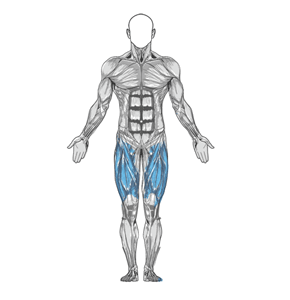
-
Stand with your torso upright holding your feet hip distance apart. Place your hands on your hips or in front of you for balance. This will be your starting position.
-
Engage your core and keep your head upright.
-
Step forward with your left leg around 2 feet or so from the foot being left stationary behind and lower your upper body down, while keeping the torso upright and maintaining balance. Inhale as you go down.
-
Using mainly the heel of your foot, push up and go back to the starting position as you exhale.
-
Repeat the movement for the recommended amount of repetitions and then perform with the right leg.
CAUTION
-
This is a movement that requires a great deal of balance so if you suffer from balance problems you may wish to either avoid it or just use your own bodyweight while holding on to a fixed object.
-
Definitely never perform with a barbell on your back if you suffer from balance issues.
TIPS
STARTING POSITION

ENDING POSITION

-
Do not allow your knee to go forward beyond your toes as you perform the exercise, as this will put undue stress on the knee joint. Make sure that you keep your front shin perpendicular to the ground.
VARIATIONS
-
There are several ways to perform the exercise - one way is to alternate each leg, another way is to do a static lunge where your starting position is with one of your feet already forward and you just go up and down from that starting position until you are done.
-
As an alternative you can perform this exercise in reverse by taking a large step backwards and lowering your body into the same position and pushing off your rear leg to return to the starting position.
-
A more challenging version is the walking lunges where you walk across the room but in a lunging fashion. For walking lunges the leg being left back has to be brought forward after the lunging action has happened in order to continue moving ahead.
ALTERNATIVE EXERCISES
-
Static lunges
-
Reverse Lunges
-
Walking Lunges